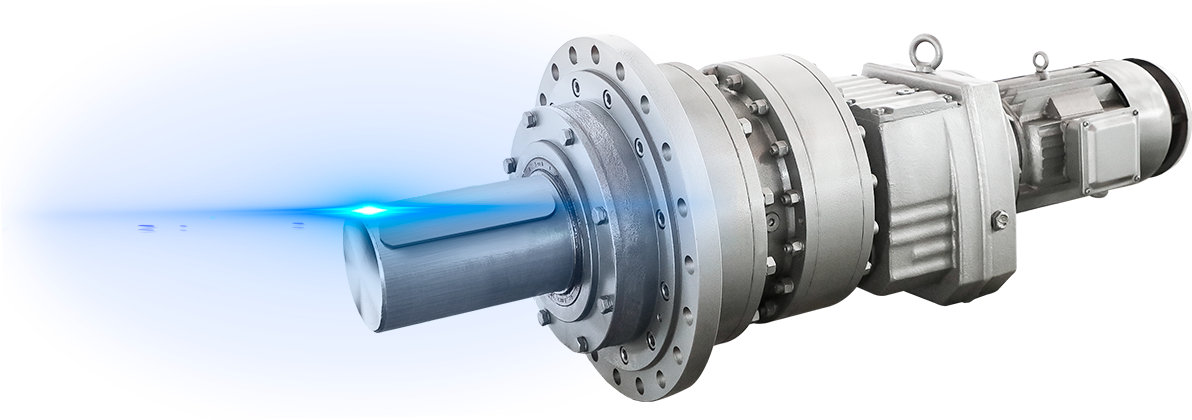
Bevel wheel/ worm wheel retarder motor
Bevel wheel retarder motor
Bevel wheel-spiral bevel gear retarder motor
Parallel axis bevel wheel retarder motor
Hard gear retarder with polyhedral
Hard gear retarder with polyhedral 2
Hard gear conical/cylindrical retarder
Hard gear cylindrical ratarder
NGW planetary gear retarder
NGW-S spiral bevel gear planetary retarder
HZ planetary / retarder for building tower
Planetary gear retarder-of high carrying capacity
Cycloidal needle wheel retarder
Hard gear vertical retarder mixer stand
Worm retarder
Worm retarder motor
Electric rotary drum
Particular mini-type gear retarder motor
 
 
  Gear Backlash 返 回
发布日期:[2008-4-25]    共被浏览[743]次
    Introduction
Properly functioning mechanical systems need to have a certain “clearance” (“gap”, “play”) between the components transmitting motion under load.

Clearance is necessary to avoid interference, wear, and excessive heat generation, ensure proper lubrication, compensate for manufactur-ing tolerances, etc. Clearance in the gear mesh means that the gap between the teeth of one gear is by a small amount larger than the tooth width of the mating gear. We also find a certain clearance in the rolling bearings, namely a small clearance between the inner race, rolling body (ball, roller) and outer race of the bearing. The key and keyway of a shaft or hub usually have clearance also.
Gearbox Rotational Backlash
The clearance of the main gearbox components (named above), at a load reversal, causes the output shaft to turn a slight angle even though the input is locked (not turning). “Input” and “output” of a gearbox is a matter of definition: in a speed reducer the output is the low-speed end, in a speed increaser it"s the high-speed end. The value of the shaft “turn angle at zero load” is called the rotational back-lash of the gearbox. Fig 1. shows the theoretical diagram of the angular turn of the gearbox shaft the over applied torque.
 
Theoretically, there is no torque required to the backlash. i.e. this portion of the angular turn is load independent. However, in real world systems a certain torque is needed to overcome internal friction to “settle the clearance” in the components. With increased torque the components deform elastically, which appears at the output shaft as a load dependent angular turn. Its magnitude is the measure for the stiffness of the gearbox.

Backlash is not an important issue for gearboxes used in applications where there is no load reversal or the position after a reversal is not critical. In precision positioning applications with frequent load reversal (such as robotics, some automation tasks etc.) the backlash directly influences the positioning accuracy (See also Lost Motion).

Therefore, servo gear heads designed for these type of applications are made with a very low, strictly defined and controlled backlash and high stiffness.
 
Backlash Defined and Measured
As mentioned above, the backlash of a gearbox can be defined (measured) at the output (at locked input) or at the input (at locked output).

There is no strict standard (such as AGMA, ISO, DIN, etc.) mandating the measurement and listing of the gearbox backlash at the input or at the output. (This is correct since the definition of the input and output side of a gearbox depends on how the gearbox is used in an application, either as a speed increaser or a speed reducer).

The relationship between the backlash at the input and output depends basically on the reduction ratio:
 
Note!
The above equation is theoretical. Deviations can be experienced when measuring, particularly with multiple stage gearboxes, since the effects of the individual clearances depend upon where the clearance is in the “gear train”. Furthermore, the clearances are not exactly the same in each mesh.

Servo gearheads have a well-defined input side, namely the side where it is connected to the motor. It is an unwritten “industry standard” to list the backlash referenced to the output side (which is almost in all cases the slow-speed side).

Rotational backlash is measured in units of angular degrees and its fractional (minutes and seconds) or it can be measured as an arc value to the angle in radians. Since the backlash is generally a fairly small angle it is mainly measured in angular minutes. Unfortunately, it became common to call it “arc minutes”, which is a mathematical and physical nonsense because the arc of an angle is not measured in minutes but in radians.

The correct unit for the rotational backlash of a gearbox is the "angular minute”

A true precision low-backlash servo gearhead has a backlash of 2 to 8 angular minutes (measured at he output).
Backlash Measurement
Even though it appears trivial, to measure correctly the backlash of a gearbox requires a proper test rig and instrumentation. The fixture holding the gearbox and its output shaft should be as be as rigid as possible. The generally very small rotational angle of the output shaft can be measured direct by a precision encoder or by indirect methods. The indirect method utilizes mainly a long rigid arm at the shaft allowing measuring the displacement at a defined distance with a dial indicator and calculating the corresponding rotational angle. (See Fig.3)
 
Since a certain amount of torque is required to overcome all clearances in the system, the most exact method is to measure a complete load reversal cycle of the gearbox (from zero to clockwise rated torque load torque value, followed by unloading and torque reversal to the counter clockwise rated torque value). See Fig 2 and Fig. 3. By this means a whole “hysteresis plot” of the gearbox is obtained, which will determine not only the true backlash but also the “torsional stiffness” (See Tortional Stiffness) of the gearbox and the “lost motion” at any given load .

 
返 回
 
Copyright © 2006 China Star-river Machinery Manufacturing Co.,Ltd    
Wenzhou Base: Xinghe Industry Zone, Aojiang Town, Pinyang County, Wenzhou City, China P.C.:325401
Hangzhou Base: No. 60, Bin-Wen Road, Binjiang District, Hangzhou City, China P.C.:310051 Tel:0086-0571-89988755
Company Homepage: www.china-sr.com      Email: sr@china-sr.com